
Have you heard of Maslow’s Hierarchy of Needs?
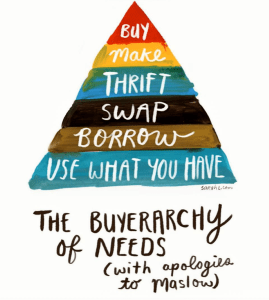
If not, search the internet to read more. This post is not about Abraham Maslow, but rather about Sarah Lazarovic, who coined the phrase, “Buyerarchy of Needs,” and borrowed the Needs pyramid to apply alternatives to buying new clothes, especially fast fashion brands. Click here for a list of these fast fashion brands.
For those who don’t know where or how to start converting from a buyer mentality to a sustainable economy, the Buyerarchy of Needs shows you the way. To become more sustainable, start at the bottom of the pyramid and work your way up.

Why Changing Our Buying Behaviors Is Important To The Planet
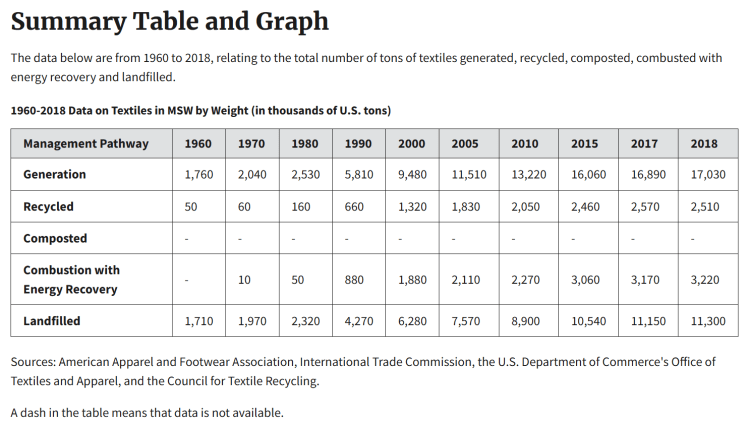
In the United States alone, close to 17 million tons of textile waste were generated in 2018, of which only 15% (2.5 tons) was recycled or reused. The rest (14.5 tons) was sent to landfills or incinerated, exacerbating greenhouse gas emissions, microplastics pollution, and chemical pollution. This data is from 2018, and it is staggering.
The trend of fast fashion in the United States as a significant factor to climate change is the same in other countries.
EPA’s Textile Waste Data in the U.S (in tons), 1960 – 2018
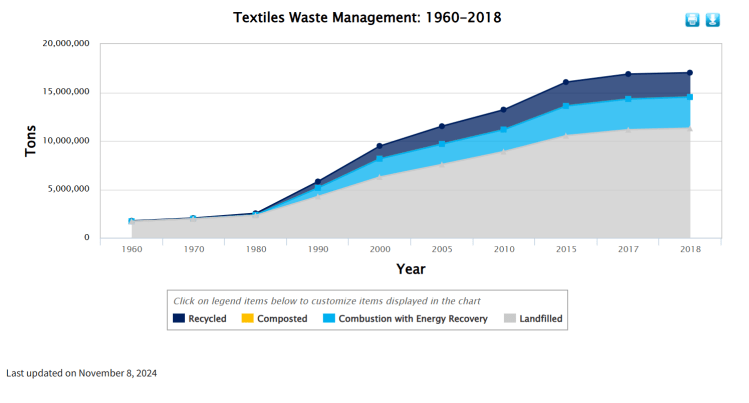
Below is the data table and graph on the number of TONS of textile waste during the time period, 1960 – 2018, and it is alarming. Since then, the amount of textile waste hovers around 17 to 18 tons per year in the U.S. The fast fashion business model of throw-away clothing began in the early 1990’s with a corresponding 130% increase in textile waste from 1980 to 1990. And the amount of textile was has continued to rise since then. As the data table shows, most of the textiles is landfilled. All of this pollution is affecting animal life, human health, human life, waterways, marine and wild animal life, and the very air we breathe.
~Revive Repurpose Reimagine~
Here is another quicker understanding of the EPA data on textile waste from 1960 through 2018 in graph form. The takeaway from this is…we need to do less buying, and more upcycling, recycling and repurposing.
Let us take the road less traveled by buying less, and doing more with upcycling, recycling, repurposing, and reusing.
Sources:
- Buyerarchy of Needs, Sarah Lazarovic
- Environmental Protection Agency (EPA), Textiles: Materials-Specific Data
🐼🐼🐼🐼🐼🐼🐼🐼🐼🐼🐼🐼🐼🐼🐼🐼🐼🐼🐼🐼🐼🐼🐼🐼🐼🐼🐼🐼🐼🐼🐼
Discover more from urban HANDmades
Subscribe to get the latest posts sent to your email.
 urban HANDmades