
Here is an interesting story about a backyard experiment on the biodegradability of natural and synthetic fibers used in clothing and many other industries. The takeaway is this: when left outside exposed to the elements, natural fibers decompose while synthetic (plastic) fibers do not. Natural fibers such as cotton, wool, linen, silk, ramie take about 1 year to break down into organic matter. Plastic fibers (synthetic) like polyester, acrylic, nylon, spandex, and olefin do not break down. Meaning, synthetic fibers, which are man-made and made with petrochemicals, can break down or decompose in 500 years…essentially never.
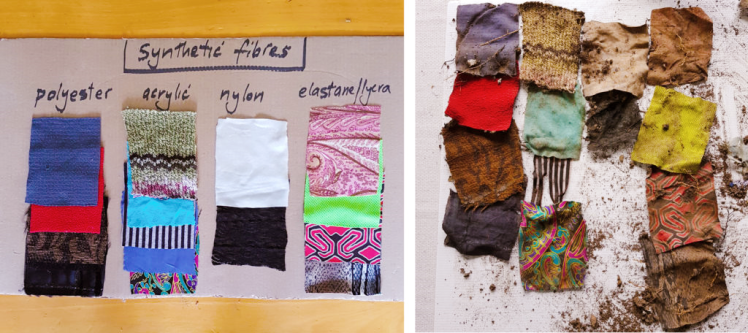
Below are photos of the experiment performed by Jane Milburn of Textile Beat on the biodegradability of synthetic and natural fibers.
Synthetic Fibers
Natural Fibers
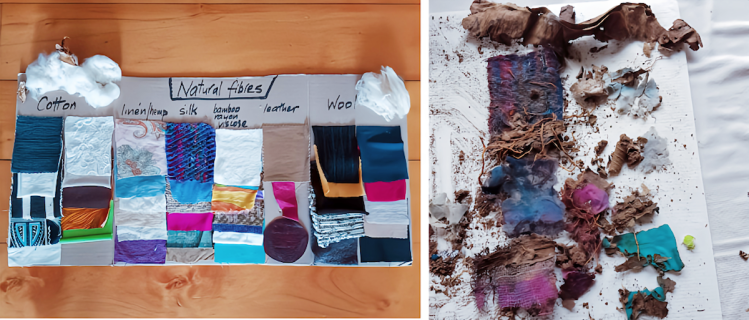
So, the backyard experiment on natural and synthetic fabrics and their biodegradability that Jane Milburn did in 2018-2019 shows that natural fibers decompose within one year, while synthetic fabrics retained their shape and color, which is not a good sign.
To read more on the sustainability of natural versus man-made (synthetic=plastic) fibers, go to Project CECE.
Ann Marie bonneau
We don’t need a handful of people doing zero waste perfectly.
We need millions of people doing it imperfectly.
Comparing Natural Fibers & Synthetic Fibers: Advantages and Disadvantages
Advantages & Disadvantages:
FEATURES | NATURAL FIBERS | SYNTHETIC (PLASTIC) FIBERS |
| Source | Plants/Animals | Made from chemicals (man-made) |
| Eco-Friendliness | Biodegradable | Plastics are forever, non-biodegradable |
| Comfort | Soft and breathable | Much less breathable |
| Durability | Less durable than synthetic | Very durable |
| Maintenance | Moderate (needs care) | Low (easy care) |
| Cost | Typically higher | Cheaper |
| Environmental Impact | Farming & water-intensive | Environmental pollution & energy-intensive |
For me, deciding whether to choose natural fibers vs plastic fibers in my clothing and other home goods is a no-brainer! Since sustainability and caring for the earth are my goals, buying clothing and other textile goods made of plastic fibers goes contrary to my beliefs.
Synthetic fabrics, such as polyester, nylon, and acrylic, are harmful to the environment due to their reliance on fossil fuels and their non-biodegradable nature. These materials are derived from petroleum, a non-renewable resource, and their production emits significant greenhouse gases, contributing to climate change. Additionally, when synthetic clothing is washed, it sheds tiny plastic fibers known as microplastics, which often end up in oceans and waterways, harming marine life and entering the food chain. Unlike natural fibers, synthetic fabrics do not decompose easily, leading to long-term pollution in landfills. Overall, the environmental footprint of synthetic textiles is substantial and deeply concerning.
Sources:
- Textile Beat: Synthetic Fibers do not break down
- Project CECE. Natural vs Synthetic Fabrics: What’s More Sustainable
We need to challenge ourselves to become more environmentally sustainable, reduce waste, and care for the earth.
Can you do that?
🐧🐧🐧🐧🐧🐧🐧🐧🐧🐧🐧🐧🐧🐧🐧🐧🐧🐧🐧🐧🐧🐧🐧🐧🐧🐧🐧🐧🐧🐧🐧
Discover more from urban HANDmades
Subscribe to get the latest posts sent to your email.
 urban HANDmades